(Download The Free Sample  ) ) |
What is the Mediterranean Diet?
The Mediterranean diet is not a “diet†per se. It is a mix of the traditional eating habits of people living in Spain, Italy, France, Greece and the Middle East.
How to Start the Mediterranean Diet?
- Eat natural, unprocessed foods like fruits, vegetables, whole grains and nuts.
- Make olive oil your primary source of dietary fat
- Reduce the consumption of red meat (Monthly)
- Eat low to moderate amounts of fish (Weekly)
- Drink a moderate amount of wine (up to one to two glasses per day for men and up to one glass per day for women)
(*) Benefits of the Mediterranean Diet
A lot of scientists believe the Mediterranean Diet is the gold standard in healthy eating. New studies appear regularly on leading scientific journals, supporting the healthfulness of the Mediterranean Diet.
These are some examples of studies confirming its health benefits:
- Boost your heart health: Diet alone could boost your heart health [1]
- Reach your ideal weight: People following a Mediterranean style diet have more long term benefits and lose weight safely [2]
- Control your blood sugar: Mediterranean diet could help you prevent high blood sugar [3]
- Improve bones health: People from the Mediterranean countries have lower rates of hip fractures. [4]
- Improve your brain health: Antioxidants found in fruits and vegetables play an important role in cognitive capacity [5]
(*) Please note that your results may vary, and you may not get the same results when using this program due to differences in your individual history, genetics, and personal motivation. Consult your physician before beginning any nutrition program.
Foods to Eat
This is a sample food list:
Fresh fruit. Have 3 or 4 pieces of fruit every day. Make one of these fruits an orange; they are very high in antioxidants and phytochemicals, substances that protect us against problems. Berries (such as strawberries, blueberries, raspberries) are also a must in this diet because of their antioxidants. If you want to follow a Mediterranean diet, eat some fruit for dessert. That is how Mediterraneans eat their fruit most of the times.
Veggies. Have a salad in your main meals. Use olive oil and lemon for dressing; This is a powerful antioxidant combination. Tomatoes and tomato products are a staple food in the Mediterranean diet; they contain lycopene. Cut a whole tomato and spread it with olive oil and some basil as part of your side dish or include them in your salads. Sauté green beans with olive oil and garlic to have a complete Mediterranean side dish. Zucchini are also a delightful complement; sauté them with olive oil.
Whole Grains. Have a piece of whole wheat or whole grain bread with your main meals (except with pasta). Have whole wheat pasta 2 or 3 times a week. It is low in calories, and the fiber enhances the feeling of fullness.
Legumes. Eat dried beans, lentils, or garbanzo beans 2 or 3 times a week. Nutrition experts at the Michigan State University tell us that eating 2 to 4 cups of cooked legumes every week could boost our heart health. Dry beans have fiber that could reduce cholesterol from the body. Eat legumes and a piece of whole grain bread to have the perfect protein. Vegetable protein does not put a load on kidneys as animal protein does.
Nuts. Have a handful of nuts as a snack in your morning break. Nuts are also a staple food in Mediterranean countries and are high in monounsaturated fat, the one that does not get stuck in the arteries. Read the food label and be aware of portions because nuts are high in calories. Scientific studies have found that almonds and walnuts could be the healthiest choices.
Olive oil. Use olive oil in your meals both to cook and as a condiment in your salads. Olive oil is the main source of fat in Mediterranean countries and could be the “cause†of the low incidence of heart problems in those countries [7]. Use olive oil and lemon as a dip in your salads.
Fish and sea food. Have fish and sea food two or three times a week. Salmon and sardines are excellent choices because they provide omega-3 oils, oils that the body needs but cannot create in enough quantities.
Garlic and aromatic herbs. Use garlic and aromatic herbs as condiment. Garlic could be the leading contributor to the low incidence of high blood pressure in Mediterranean countries [8].
Sample Mediterranean Diet Menu
A 28 day diet plan would introduce changes gradually. Studies have shown that small changes over time are an effective way to make lifelong habits. Start with the elimination of processed foods and increase fruit and vegetable. Continue by adding more beans and switch from other oils (or butter) to extra virgin olive oil. Limit seafood, poultry and eggs to a few times per week each and reduce red meat to no more than a portion a month. And finally focus on dairy products and avoid milk, cream and butter.
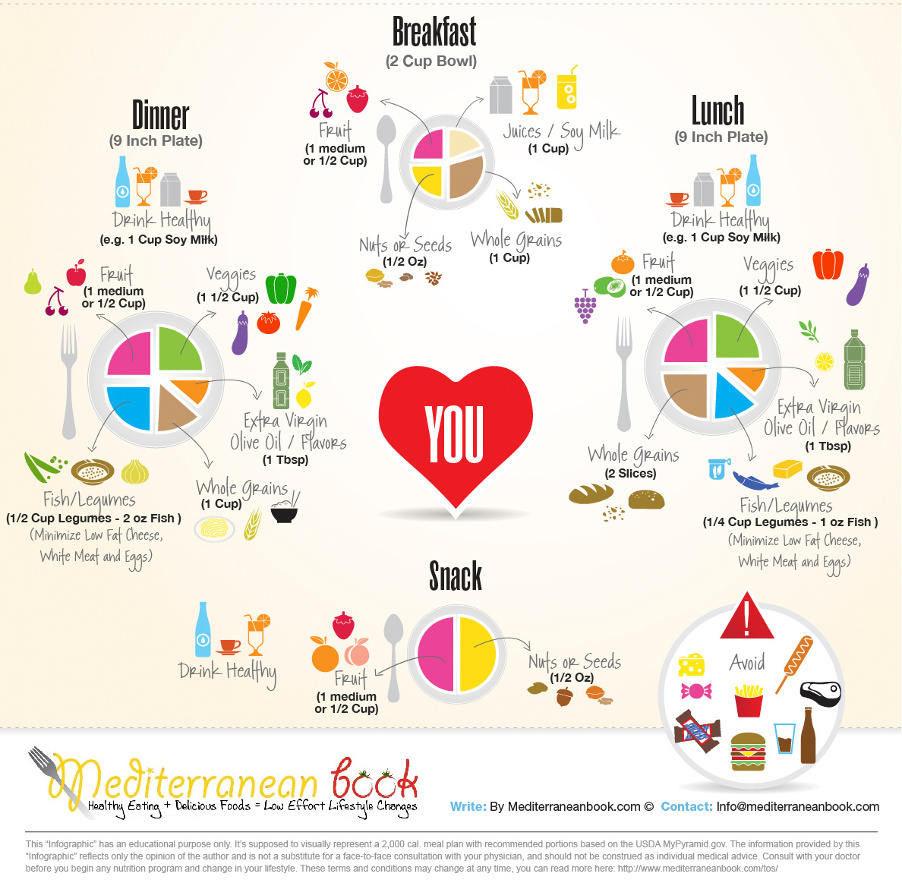
It is difficult to choose just one menu, but here’s what a day’s worth of meals might look like:
- Breakfast: Greek yogurt topped with berries and walnuts; Coffee or tea
- Lunch: Lentil soup with swish chard topped with taziki sauce; Hummus and pita
- Snack: Whole grain crackers and cheese
- Dinner: Roasted cod paired with a wheat berry salad consisting of olive oil vinaigrette, feta, parsley, and tomatoes and a glass of red wine
- Dessert: Fresh fruit drizzled with honey
How to Lose Weight While on the Mediterranean Diet?
Eat a minimum of five servings of fruits and vegetables daily. Choose foods rich in fiber, vitamins and phytonutrients. Eat legumes at least 8 times a week. Legumes are a low fat, fiber filled and a good source of protein. Limit refined grains and choose whole grains. Lower fat dairy options should replace full fat dairy products. Olive oil would be limited to a tablespoon per day. The human body requires dietary fat, and plant based olive oil is a heart healthy choice.
Fish, eggs and poultry should be limited to no more than two servings each, per week. These are good sources of protein but contain more calories than legumes. Wine should be limited to one glass per day. A four ounce glass of red wine is full of antioxidants but contains 100 to 120 calories.
Eat fruit for dessert. Consume no more than 2 eggs a week. Replace butter with olive oil for cooking. Use honey to sweeten (no sugar). Eat red meats once a month. Put in 30 min. of moderate physical activity each day.
Sample Menus
A nice breakfast idea would include a 1/2 cup serving of oats with fruit or granola with milk. Greek style yogurt with fruit and nuts is a great choice for yogurt as it contains more protein than regular yogurt. An even higher protein choice might include a vegetable filled egg white omelet with whole grain toast.
Lunch would account for 350 to 400 calories. As always, emphasize fresh and minimally processed foods. Lunches would be made up of bean based soups, salads with beans and an olive oil dressing, light seafood or poultry dishes and whole grains. Hummus and vegetables in a whole wheat pita is an example of a plant based sandwich that would make a tasty lunch option. Ideally lunch should include at least three fruit or vegetable servings.
Dinner would be in the 400 calorie range. Dinner options are virtually identical to lunch, with an emphasis on fresh vegetables, legumes and whole grains. For variety, grains like Quinoa, though not traditionally Mediterranean, can be used in salads or as a side dish. Again, dinner should include at least three fruit and vegetable servings. Grilled fish and vegetables make a delicious dinner choice.
A 50 to 100 calorie snack of a few nuts, vegetables or fresh fruit would complete the daily calorie intake.
Some delicious breakfast options would be a high protein Greek style yogurt with granola and fruit topping, a spinach and tomato omelet made with a combination of whole egg and egg whites accompanied by fresh fruit. Steel cut oats or other whole grain hot cereal with fruit is also an excellent choice.
Lunch would be approximately 500 calories and focus on fresh foods and legumes or lean protein. An example of a lunch that would fit the Mediterranean diet is a grilled vegetable medley served over polenta, accompanied by a side salad with feta. Both lunch and dinner should include a minimum of three vegetable servings. Dinner leftovers make an easy lunch the next day.
Dinner options are the same as lunch, with the focus on nutritious, unprocessed foods and at least three vegetable servings. Fish or chicken with rice, vegetables and a salad makes an easy but elegant dinner. For busy nights, bean soups could be prepared ahead and easily reheated. Serve the soup with salad and whole grain bread for a quick comforting meal. A single glass of red wine can accompany dinner.
The rest of the calories would be made up by two 100 calorie snacks. Yogurt, whole grain crackers or fruit make healthy snack choices.
Some Information
(2) Esposito, Katherine, et al. “Mediterranean diet and weight loss: meta-analysis of randomized controlled trials.” Metabolic syndrome and related disorders 9.1 (2011): 1-12.
(3) Ryan, M., et al. “Diabetes and the Mediterranean diet: a beneficial effect of oleic acid on insulin sensitivity, adipocyte glucose transport and endotheliumâ€dependent vasoreactivity.” QJM: An International Journal of Medicine 93.2 (2000): 85-91.
(4) Puel, Caroline, Véronique Coxam, and Marie-Jeanne Davicco. “[Mediterranean diet and osteoporosis prevention].” Medecine sciences: M/S 23.8-9 (2006): 756-760.
(5) Scarmeas, Nikolaos, et al. “Mediterranean diet and risk for Alzheimer’s.” Annals of neurology 59.6 (2006): 912-921.
(6) Keys, Ancel. “Coronary problems in seven countries.” Circulation 41.1 (1970): 186-195.
(7) Covas, MarÃa-Isabel, et al. “The effect of polyphenols in olive oil on heart risk factors: a randomized trial.” Annals of Internal Medicine 145.5 (2006): 333-341.
(8) Silagy, Christopher A., and H. Andrew W. Neil. “A meta-analysis of the effect of garlic on blood pressure.” Journal of hypertension 12.4 (1994): 463-468.
